
In today’s ever-evolving information landscape, media platforms, both legacy (traditional or mainstream outlets like newspapers, TV, radio, etc.) and alternative (independent websites, social media influencers, unconventional news platforms, etc), wield unprecedented influence in shaping public opinion. Within this media ecosystem, gaining familiarity with the inherent “failure conditions” of each media type is becoming increasingly important. For the reader unfamiliar with the term, a failure condition is a characteristic that can undermine the credibility and reliability of a media source, thereby affecting the quality and objectivity of the information it disseminates.
Presuming a general understanding of legacy media’s pitfalls by most media consumers, in this essay, the author, writing on such a platform as that presently under analysis, spotlights the key failure conditions specific to the less-explored realm of alternative media. However, before we examine the alternative media landscape, let’s first, for balance, recap the main shortcomings of the legacy media.
Legacy Media:
- Biased Reporting: Traditional media outlets have faced criticism for bias, often rooted in political or corporate affiliations. An example is The Sun newspaper, known for having a conservative bias, while The Guardian is often perceived as leaning liberal.
- Gatekeeping: Some legacy media entities have been criticised for gatekeeping, controlling the narrative by deciding which stories get published. An illustrative example is the BBC’s editorial decisions during contentious political events or the Coronavirus pandemic, which some viewers perceive as biased.
- Sensationalism: Sensationalism is a common pitfall in traditional media, where captivating and dramatic stories are prioritised over substantive news. Tabloid newspapers like the Daily Mail often employ sensationalised celebrity gossip and attention-grabbing headlines.
- Declining Trust: Trust in traditional media has eroded over time due to perceived biases, sensationalism, and a perceived lack of accountability. Public trust in media institutions, including newspapers and broadcasting companies, has steadily declined in various surveys.
- Inaccurate Representation: Traditional media frequently provides inaccurate or incomplete representations of certain groups, perpetuating the lack of inclusivity in news and entertainment. The film industry, for instance, has long been criticised for its underrepresentation of minorities both in front of and behind the camera, highlighting the need for improved diversity and inclusion.
- Commercialisation: Traditional media often prioritises profitability over quality, compromising objectivity. This pursuit of revenue may lead to sensationalism, prioritising entertainment over information and suppressing critical stories detrimental to commercial interests. Recognising profit motives in media decision-making is crucial for assessing credibility.
Having now reminded ourselves of the primary failure conditions of legacy media, let’s shift our focus to the alternative media landscape. We will delve into its significant drawbacks, provide more comprehensive definitions, and explore methods for identifying these issues.
Alternative Media
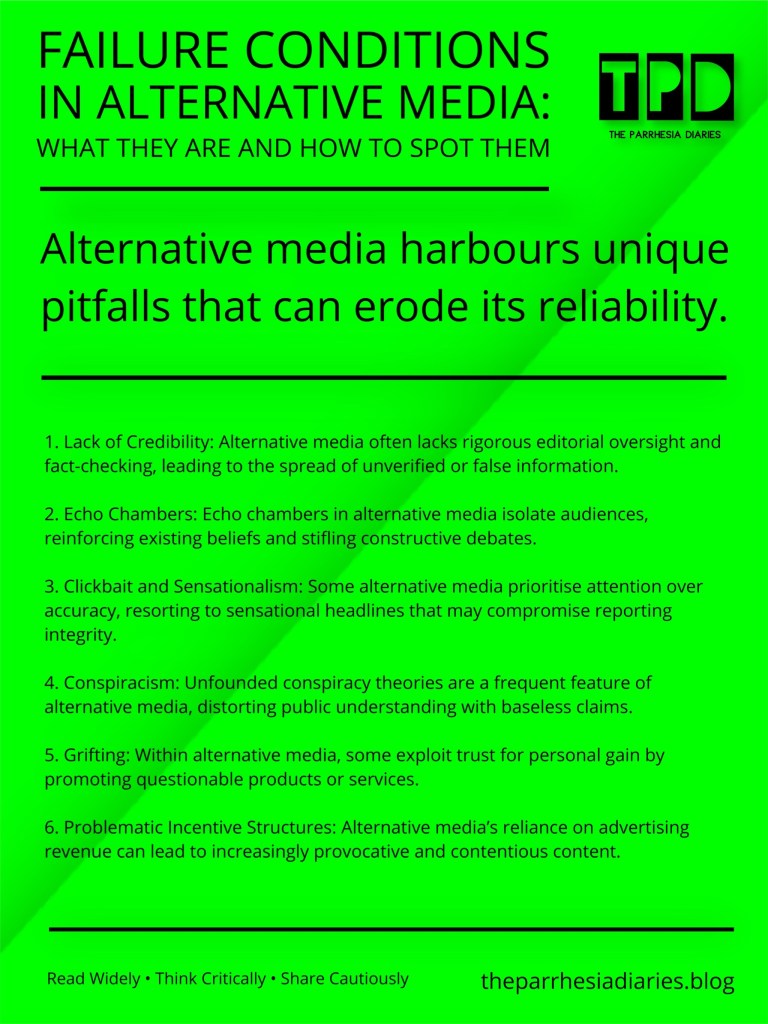
- Lack of Credibility: In the world of alternative media, a conspicuous absence of rigorous editorial oversight, a hallmark of traditional journalism, often prevails. This deficiency can lead to the unrestrained dissemination of unverified or entirely false information. Here, platforms may skirt established editorial standards, lack robust fact-checking processes, and forego external verification mechanisms. Such lax practices lay the foundation for the unchecked spread of sensational or outlandish claims, often devoid of credible sources or supporting evidence. Recognising the potential harm stemming from misinformation is imperative for responsible media consumption.
Spotting the Issue: Watch out for outlets lacking editorial standards, fact-checking processes, or external verification. Be cautious of sensational or unsubstantiated claims. - Echo Chambers: The unique capacity of alternative media to cultivate echo chambers within its audience, a phenomenon where individuals are consistently exposed to content reinforcing their preexisting beliefs, perpetuates confirmation bias. The consequences of such isolation can be profound. Observing the absence of constructive debate and a pervasive shortage of dissenting perspectives within digital spaces housing alternative media is a telling sign of the presence of echo chambers. In an era where diverse perspectives are increasingly critical for informed discourse, recognising the value of such variety becomes imperative.
Spotting the Issue: Look for digital spaces where audiences are mainly exposed to content confirming their existing beliefs, leading to a lack of constructive debate and dissenting views. - Clickbait and Sensationalism: Within the realm of alternative media, the allure of attracting viewers sometimes takes precedence over accuracy and credibility. Some outlets prioritise crafting click-worthy headlines and sensational content, often resorting to hyperbole or dramatisation. These tactics, designed to draw attention at any cost, may compromise the integrity of reporting. Identifying the use of sensational or alarmist language in headlines or article content is a useful marker. Vigilance is key, as information presented in an overly dramatic or emotive manner may indicate a focus on gaining viewership rather than providing balanced and factual reporting. Developing critical thinking skills is vital in navigating this landscape of sensationalism and ensuring media literacy.
Spotting the Issue: Identify the use of sensational language in headlines or articles. Be vigilant against overly dramatic content. - Conspiracism: Alternative media frequently promotes and propagates unfounded conspiracy theories, a phenomenon with the potential to distort public understanding significantly. This often involves baseless or implausible claims that lack credible evidence. Conspiratorial content relies on suggesting hidden motives, secret agendas, or cover-ups without substantial supporting facts. In the face of such content, promoting evidence-based scepticism becomes crucial to responsible media consumption, allowing for the delineation between unsubstantiated claims and factual information.
Spotting the Issue: Pay attention to claims without credible evidence. Promote evidence-based scepticism to distinguish between unsupported claims and factual information. - “Grifting”: The landscape is not immune to individuals and entities engaging in “grifting”, a practice where trust is exploited for personal gain. A case in point can be found within the realm of wellness influencers who prioritise promoting products or services with questionable benefits or dubious claims for financial profit. Such behaviour should raise vigilance among media consumers. The alignment of profit motives with unverified health or wellness claims serves as a red flag, and thus, promoting scepticism and fact-checking in health and wellness content becomes paramount for public well-being.
Spotting the Issue: Be cautious when influencers promote questionable products or services with unverified health claims. Promote scepticism and fact-checking. - Problematic Incentive Structures: Alternative media frequently relies on advertising revenue and viewer engagement, creating a powerful incentive to prioritise content designed for maximum clicks and controversy. As these platforms gain popularity, content creators may recalibrate their output to cater to evolving audience preferences. This adjustment can result in shifts towards more extreme positions as creators chase attention and revenue. In such instances, vigilant viewers should watch for content creators who consistently deliver increasingly provocative or contentious content, evidently aimed at maximising engagement and revenue. Recognising the role of incentives in content creation is crucial for media literacy, as it offers insights into the motives driving the content and the potential impact on its objectivity and credibility.
Spotting the Issue: Watch for consistent delivery of provocative content to maximise attention and revenue. Recognise the role of incentives in content creation for media literacy.
Navigating the complex media landscape demands vigilance and discernment. Failure conditions, whether in legacy or alternative media, pose significant challenges to the integrity and reliability of information. It is increasingly vital to recognise these conditions as they emerge, influencing the content we consume.
By understanding the dynamics of media outlets, their financial incentives, and audience dynamics, media consumers can act as gatekeepers of information integrity. Whether challenging sensationalism, combating echo chambers, or questioning credibility, a critical mindset is essential.
In this ever-evolving media landscape, informed and astute media consumers play a crucial role in ensuring the responsible dissemination of information, promoting a more informed and discerning society.
Media Analysis Sources
Below is a selection of some of the more reliable media-analysis websites to help with your discernment.
- Ad Fontes Media: Ad Fontes Media offers an insightful media bias chart, which visually represents the political bias and reliability of various media outlets. Ad Fontes Media
- Media Bias/Fact Check: This website provides comprehensive media bias ratings and fact-checking services, helping readers assess the credibility of news sources. Media Bias/Fact Check
- Poynter’s MediaWise: Poynter’s MediaWise is a valuable resource for media literacy, offering fact-checking and educational tools to help the public discern credible news from misinformation. Poynter’s MediaWise
- NewsGuard: NewsGuard provides detailed evaluations of news websites, highlighting their credibility, transparency, and potential biases, helping readers make informed choices about their news sources. NewsGuard
- The Trust Project: The Trust Project promotes transparency and accountability in journalism, offering tools for readers to assess the reliability and trustworthiness of news outlets. The Trust Project
Supporting Infographic
 The Parrhesia Diaries