
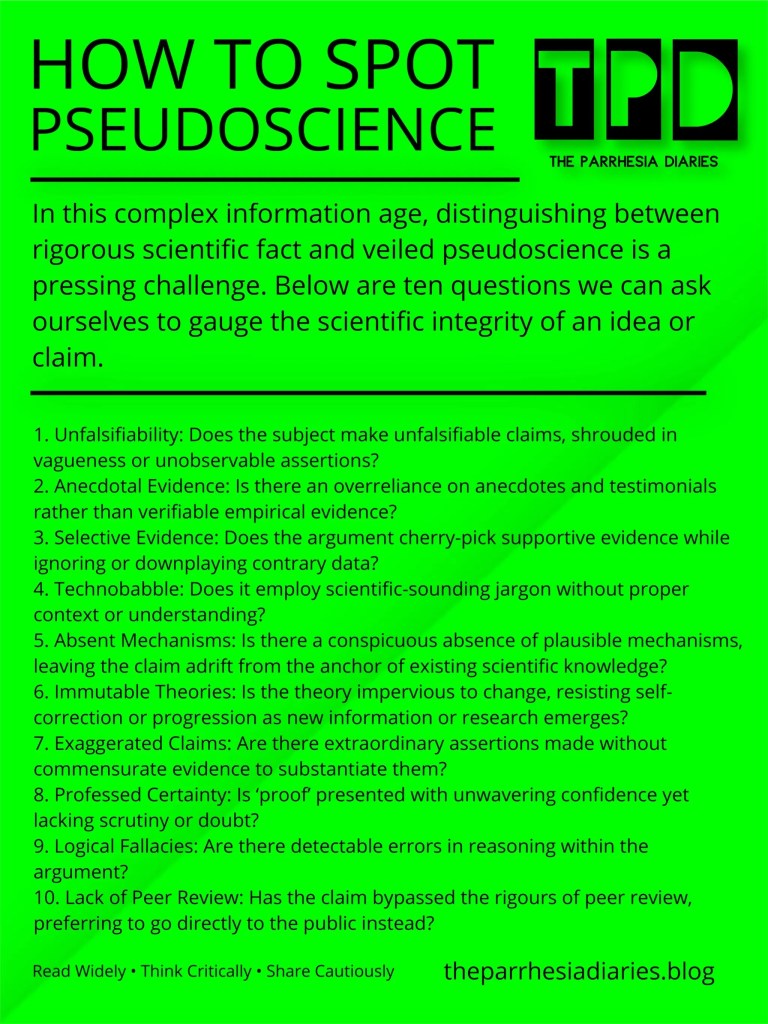
In this complex information age, distinguishing between rigorous scientific fact and veiled pseudoscience is a pressing challenge. In the vein of my previous writings on information pollution and cognitive biases, let us now consider a series of questions we can ask ourselves to gauge the scientific integrity of an idea or claim:
- Unfalsifiability: Does the subject make unfalsifiable claims, shrouded in vagueness or unobservable assertions?
- Anecdotal Evidence: Is there an overreliance on anecdotes and testimonials rather than verifiable empirical evidence?
- Selective Evidence: Does the argument cherry-pick supportive evidence while ignoring or downplaying contrary data?
- Technobabble: Does it employ scientific-sounding jargon without proper context or understanding?
- Absent Mechanisms: Is there a conspicuous absence of plausible mechanisms, leaving the claim adrift from the anchor of existing scientific knowledge?
- Immutable Theories: Is the theory impervious to change, resisting self-correction or progression as new information or research emerges?
- Exaggerated Claims: Are there extraordinary assertions made without commensurate evidence to substantiate them?
- Professed Certainty: Is ‘proof’ presented with unwavering confidence yet lacking scrutiny or doubt?
- Logical Fallacies: Are there detectable errors in reasoning within the argument?
- Lack of Peer Review: Has the claim bypassed the rigours of peer review, preferring to go directly to the public instead?
Much like our collective responsibility to battle information pollution, we must apply similar diligence to recognise and challenge pseudoscience. By asking these questions, we can better evaluate the integrity of the information we consume and share, reducing our susceptibility to pseudoscientific narratives. As always, it is about balancing healthy scepticism and an open mind but always underpinned by a rigorous scientific framework.
Read Widely • Think Critically • Share Cautiously
Supporting Infographic
 The Parrhesia Diaries