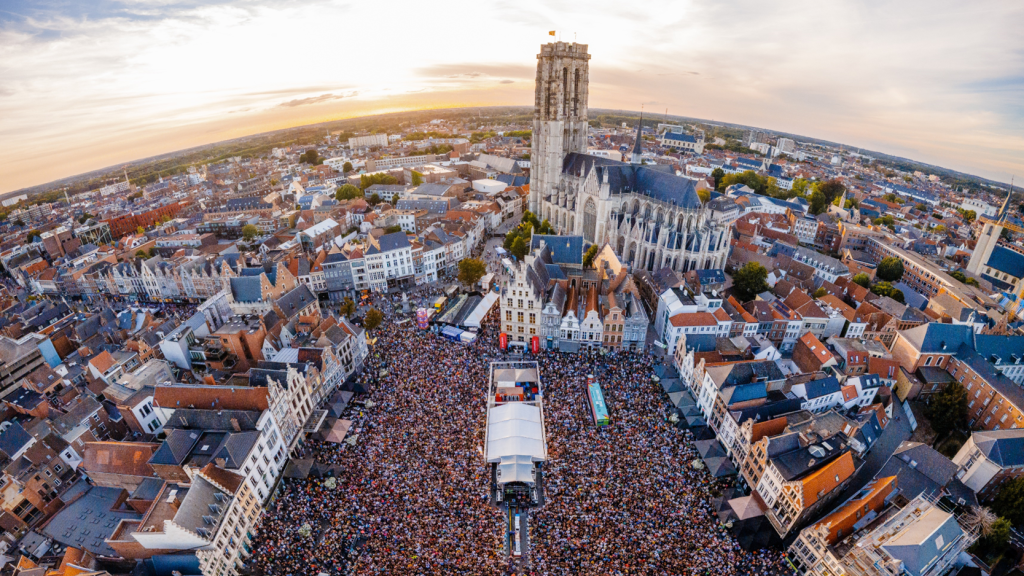
Immigration is reshaping Europe. Numbers are high. Tensions are rising. Where Multiculturalism was intended to resolve this by having diverse communities integrate and live side by side in harmony, in practice, it has far too often led to separation and disconnection. Despite best intentions, Multiculturalism has failed. This begs the question: if not Multiculturalism, then what? Mechelen, a small town of 85,000 inhabitants in Northern Belgium, serves as a good example.
A couple of decades ago, Mechelen faced high unemployment, surging crime rates, deep ethnic tensions, rising racism, and alienated, increasingly ghettoised immigrant (mostly Muslim) communities. Belgium also had the highest per-capita outflow of ISIS fighters in Europe. Yet Mechelen recorded none.
How? Through a bold experiment in Transculturalism – the idea that we should not just tolerate differences, but actively weave them into a stronger civic fabric by treating cultures as we treat people: not as monolithic and essentially fixed, but as responsible, responsive, and changeable.
In his charge, Mayor Bart Somers initiated a wide public information campaign and established a “mutual obligations” social contract: Ethnic Flemish Belgians were asked to show tolerance towards minorities and zero tolerance for the discrimination of minorities, and immigrant families were held to high social obligations, with support offered where necessary.
Other significant steps included upping police presence in key areas, thereby enhancing the sense of safety, and targeted campaigns against racism and discrimination, alongside framing tolerance as a civic duty. Furthermore, Somers convinced hundreds of middle-class families of ethnic Belgians to send their children back to schools with immigrant pupils, thereby guaranteeing standards that would rebuild trust, while increasing the number of positive interactions between ethnic groups.
Next was Somers’ most radical step: Muslim children were sent on study trips to Córdoba, Spain – once a flourishing centre of science, culture, and tolerance under Islamic rule. Instead of being told they belonged to a marginalised group, they were given a proud history of Islam as part of Europe’s story, as a civilisation that once led the world.
To summarise, with interventionist policies, natives were nudged towards openness, while immigrant communities were empowered to see themselves as a dignified, constructive part of society. Indeed, ethnic tensions were reduced, while still the cultures and heritages involved were honoured.
That’s Transculturalism. And it worked.
The Multiculturalism project has failed. It has left us fragmented, divided, and too often in conflict. Things MUST change. The alternative cannot be a retreat into nationalism. Immigration is here to stay – we need to accept that. The task, then, is to manage it most wisely. Setting sensible limits, greater integration, in short, embracing Transculturalism.
The lesson from Mechelen is clear: when natives and newcomers share in the renewal of a common civic identity, societies can move forward stronger, together.
Timeline: Mechelen’s Transformation

- Early 2000s – City plagued by segregation, high crime, and ethnic tensions.
- 2001 – Bart Somers becomes mayor, initiating a strategy of safety, inclusion, and shared civic identity.
- Mid-2000s – Visible policing reduces crime, stabilises housing, and curbs white flight.
- 2006–2010 – Campaigns against racism launched; middle-class families gradually returned to mixed schools.
- 2010s – Immigrant families held to civic obligations while supported in integration efforts.
- 2016 – Somers awarded World Mayor Prize for building “the most inclusive city on earth.”
- 2017 – Mechelen wins Best Belgian Local Government Award for excellence in public services.
- 2018–2020 – Recognised as a European Green Leaf city, praised for sustainability and urban renewal.
- 2020 – Named a finalist in the European Green Capital Award; population and businesses continue to grow (nearly 6,000 firms).
- 2021 – Featured internationally as a model for deradicalisation and integration.
- 2023–2024 – Home to residents from over 130 nationalities; continues to thrive as one of Flanders’ five “art cities” with over 300 protected monuments and 3 UNESCO World Heritage sites.
 The Parrhesia Diaries